
Global Consumer Grade Robot Dog Market Size, Growth & Revenue 2024-2033
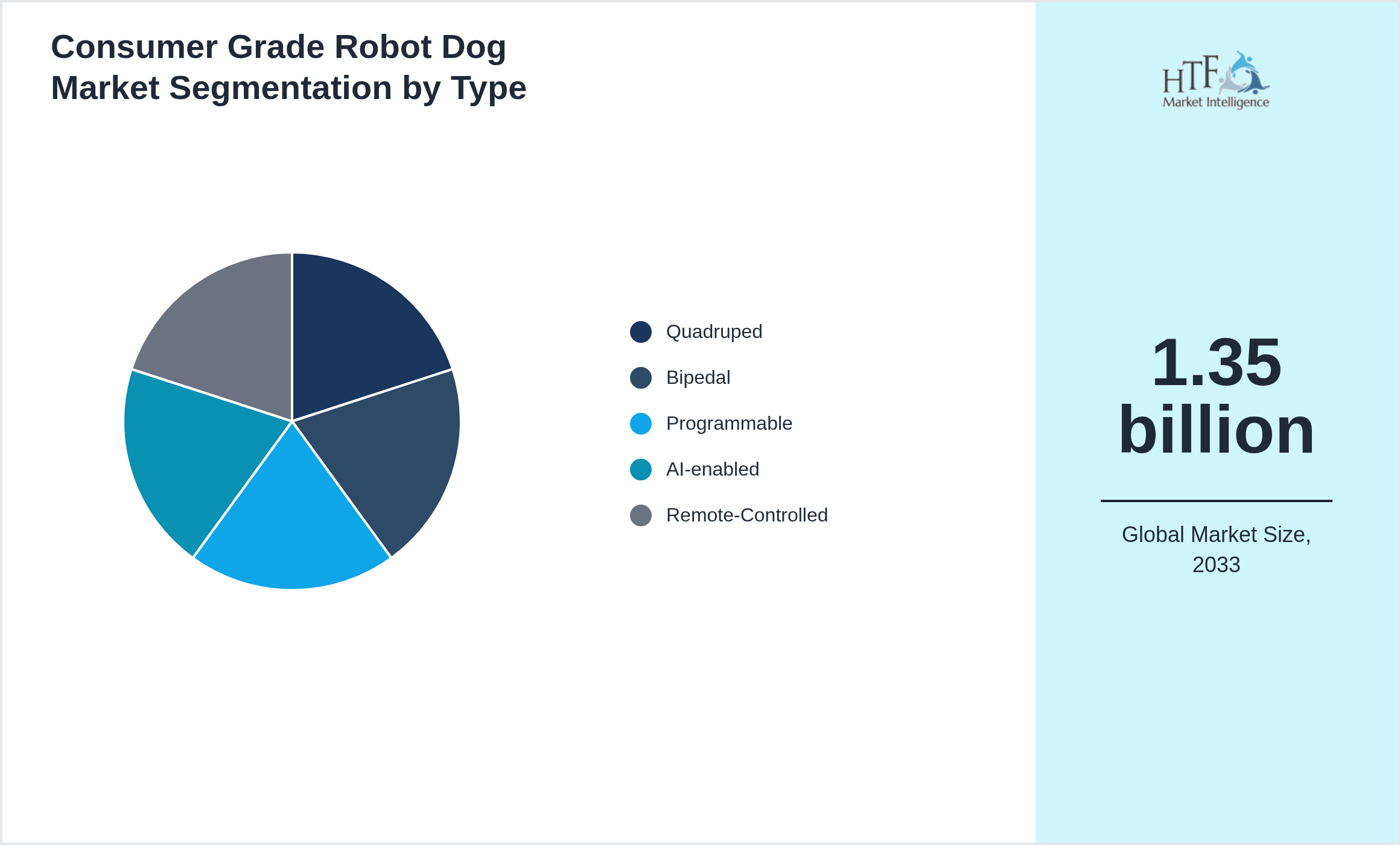
Global Consumer Grade Robot Dog Market is segmented by Application (Personal Entertainment, Education, Security, Research, Therapy), Type (Quadruped, Bipedal, Programmable, AI-enabled, Remote-Controlled), and Geography (North America, LATAM, West Europe, Central & Eastern Europe, Northern Europe, Southern Europe, East Asia, Southeast Asia, South Asia, Central Asia, Oceania, MEA)
Pricing
Report Overview
Industry Overview
The Consumer Grade Robot Dog market is expected to reach 1.35 billion by 2033 and is growing at a CAGR of11.00% between 2024 and 2033.
Consumer Grade Robot Dog refers to AI-powered robotic companion devices designed for entertainment, education, home assistance, security monitoring, emotional interaction, and smart lifestyle integration within consumer environments. These robotic systems incorporate artificial intelligence, computer vision, voice recognition, autonomous mobility, edge computing, sensor fusion technologies, and IoT connectivity to simulate pet-like interaction and intelligent behavioral responses. The market includes robotic pet companions, educational AI robots, smart home surveillance robots, programmable entertainment robots, and connected consumer robotics platforms supporting residential, educational, and lifestyle applications. Rising consumer interest in AI-driven lifestyle products, smart home ecosystems, interactive entertainment technologies, and companion robotics is accelerating commercial adoption globally. Manufacturers are integrating emotional AI systems, predictive behavioral learning, cloud-based robotic analytics, autonomous navigation capabilities, and multimodal interaction technologies to improve engagement and operational intelligence. Expansion of connected consumer electronics ecosystems and advancements in embodied artificial intelligence are further transforming the commercial scalability and innovation landscape of consumer robotics industries.
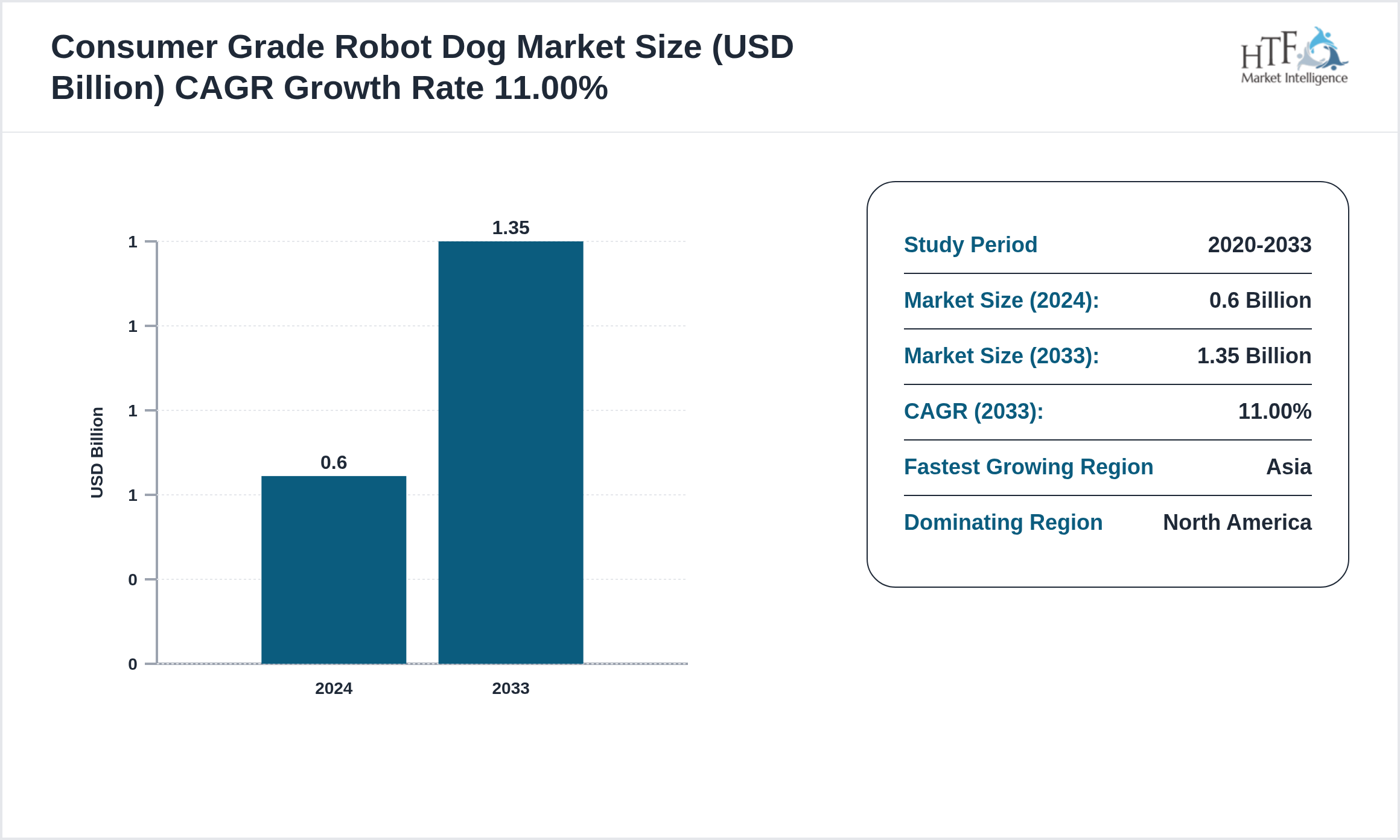
Source: HTF Market Intelligence (HTF MI)
Market Size & Forecast
Market Segmentation
Selecting segmentation criteria in Boston Dynamics (NA), Unitree Robotics (Asia), Sony (Asia), Xiaomi (Asia), Ghost Robotics (NA), Agility Robotics (NA), ANYbotics (EU), Pudu Robotics (Asia), Robotis (Asia), Robosen (Asia), Aibo (Asia), CyberDog (Asia), Sharp (Asia), Segway Robotics (Asia), WowWee (NA) involves several key steps. Researchers begin by defining their objectives, such as understanding consumer behavior or identifying market opportunities. They then gather relevant data on demographics, psychographics, and buying behavior. Next, they identify segmentation variables like age, location, lifestyle, and purchase patterns. Using analytical tools, they analyze the data to find distinct market segments and evaluate their attractiveness based on size, growth potential, and alignment with business goals. Detailed profiles are created for each segment, and the most promising ones are selected for targeting. Finally, tailored marketing strategies are developed, and the performance of these strategies is monitored and adjusted as needed. This process ensures that segmentation effectively identifies valuable market opportunities and aligns with strategic goals.
Segmentation by Type
- • Quadruped
- • Bipedal
- • Programmable
- • AI-enabled
- • Remote-Controlled
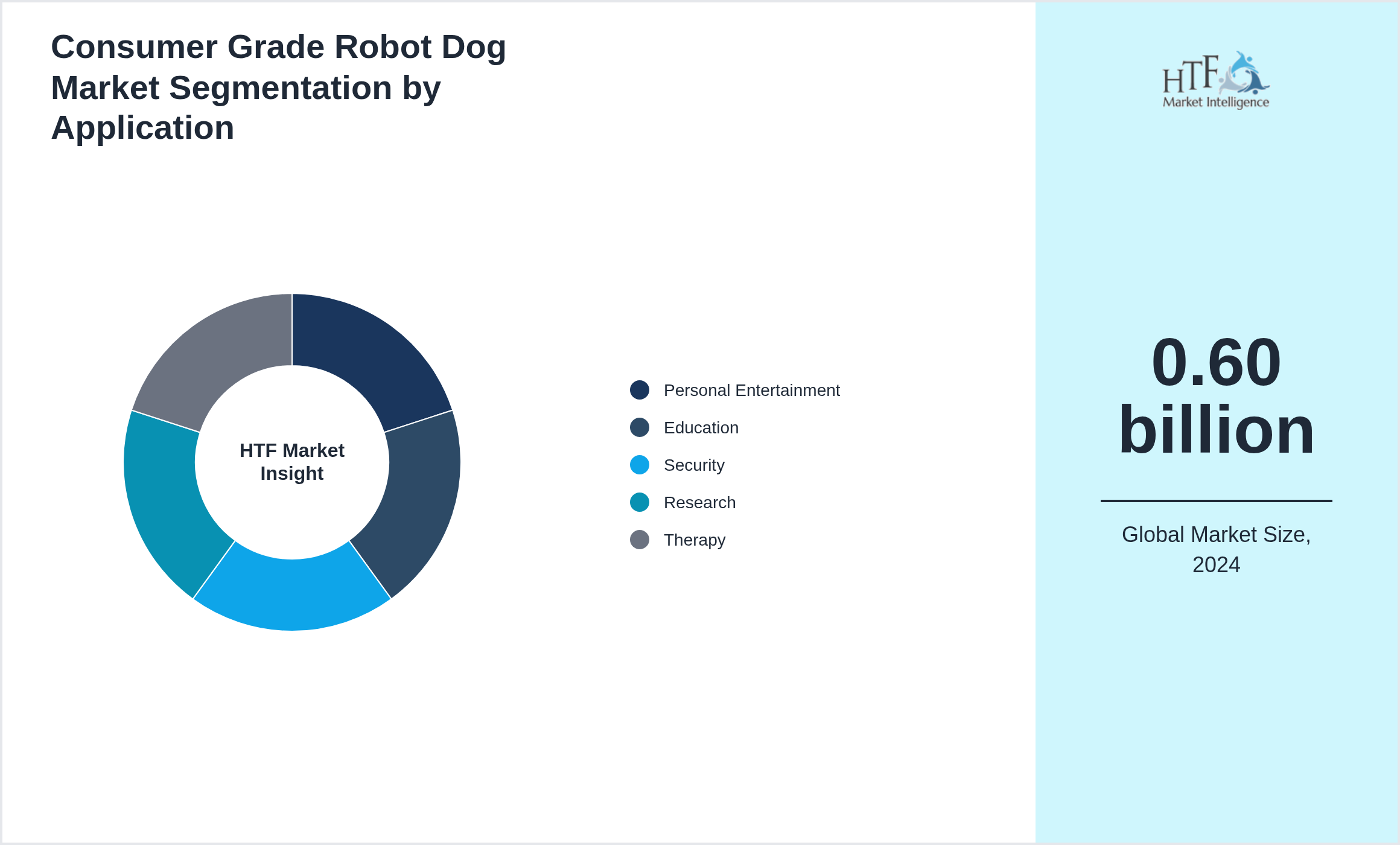
Segmentation by Application
- • Personal Entertainment
- • Education
- • Security
- • Research
- • Therapy
Consumer Grade Robot Dog Market Dynamics
TheConsumer Grade Robot Dog is driven by factors such as increasing demand in end-use industries, technological advancements, research and development (R&D), economic growth, and increasing global trade.
Influencing Trend:
- • AI-powered behavioral learning autonomous navigation and emotional interaction systems are major trends transforming the Consumer Grade Robot Dog market. Manufacturers increasingly integrate computer vision natural language processing and IoT-enabled smart home connectivity to enhance user experiences. Lightweight robotic actuators advanced battery systems and cloud-based software updates improve operational functionality and product longevity. Subscription-based AI feature upgrades and app-controlled customization tools are becoming popular among consumers. Educational coding interfaces and gamified interaction systems also strengthen product adoption among children and technology-focused households
- • Rising consumer interest in home robotics advancements in artificial intelligence and growing adoption of smart companion devices strongly drive the Consumer Grade Robot Dog market. Families technology enthusiasts and educational institutions increasingly adopt robot dogs for entertainment interactive learning and smart home integration purposes. Expansion of AI-driven mobility systems voice recognition technologies and emotional interaction capabilities further accelerates product demand globally. Increasing disposable income and rapid innovation within consumer robotics ecosystems continue supporting market expansion across developed urban regions
- • High product prices limited battery life and technical maintenance complexity remain major challenges affecting the Consumer Grade Robot Dog market. Consumer concerns regarding privacy data security and AI reliability may restrict adoption across certain demographics. Mechanical durability issues and software malfunctions increase after-sales service requirements and operational costs for manufacturers. Competition from alternative smart entertainment devices and rapidly changing technology trends intensify innovation pressure. Maintaining affordability while integrating advanced robotics capabilities and premium AI functions remains difficult within highly competitive consumer electronics markets
- • Growing demand for interactive home entertainment STEM education tools and AI-enabled companionship devices creates substantial opportunities for Consumer Grade Robot Dog manufacturers. Expansion into elderly assistance emotional wellness support and remote monitoring applications significantly broadens commercial potential. Emerging smart home ecosystems and integration with voice assistant platforms create additional cross-selling opportunities. Technological advancements in robotics miniaturization and edge AI computing support affordable product development and wider consumer accessibility. Strategic partnerships with educational institutions gaming companies and healthcare providers further strengthen long-term business scalability
Regional Insight
The North Americaregion holds a dominant market share, primarily driven by growing consumption patterns, a rising population, and robust economic activity that fuels market demand. Meanwhile, the Asia Region is experiencing the fastest growth, propelled by increasing infrastructure developments, expanding industrial activities, and a surge in consumer demand, positioning it as a key driver for future market expansion.
- North America
- LATAM
- West Europe
- Central & Eastern Europe
- Northern Europe
- Southern Europe
- East Asia
- Southeast Asia
- South Asia
- Central Asia
- Oceania
- MEA
- • North America leads the Consumer Grade Robot Dog market through strong adoption of AI-enabled consumer electronics high household spending on smart devices and rapid integration of robotics into entertainment education and home assistance applications. The United States dominates regional revenue generation due to advanced robotics research infrastructure strong venture capital investments and growing consumer interest in interactive AI companions. Major technology companies continue investing in machine learning motion sensing and edge AI computing to improve product intelligence and mobility performance. E-commerce expansion and premium smart home ecosystems further accelerate commercial adoption across urban households
- • Europe demonstrates stable market growth supported by advanced robotics engineering capabilities strict safety compliance standards and increasing demand for educational robotics platforms. Germany France and the United Kingdom lead regional innovation through strong industrial automation ecosystems and research collaboration between universities and robotics companies. Consumers increasingly prefer multifunctional robot pets with AI interaction capabilities surveillance integration and elderly companionship features. Sustainability regulations and electronic recycling requirements continue shaping product development and manufacturing strategies across the region
- • Asia Pacific represents the fastest-growing and largest manufacturing hub for Consumer Grade Robot Dog products due to extensive electronics supply chains strong semiconductor production and rising smart consumer device adoption. China Japan and South Korea dominate regional production through AI hardware innovation sensor integration and competitive manufacturing costs. Rapid urbanization tech-savvy younger consumers and growing smart home penetration continue strengthening domestic demand. Regional companies increasingly focus on affordable AI robotics emotional interaction technologies and cloud-based connectivity features to expand commercial scalability
- • Middle East markets are witnessing gradual expansion due to rising smart city investments premium consumer electronics demand and increasing adoption of AI-driven lifestyle technologies. Gulf countries continue investing in advanced robotics solutions for educational institutions hospitality and luxury residential applications. Import dependency remains high creating commercial opportunities for international robotics manufacturers and AI hardware suppliers targeting affluent urban consumers
Key Players
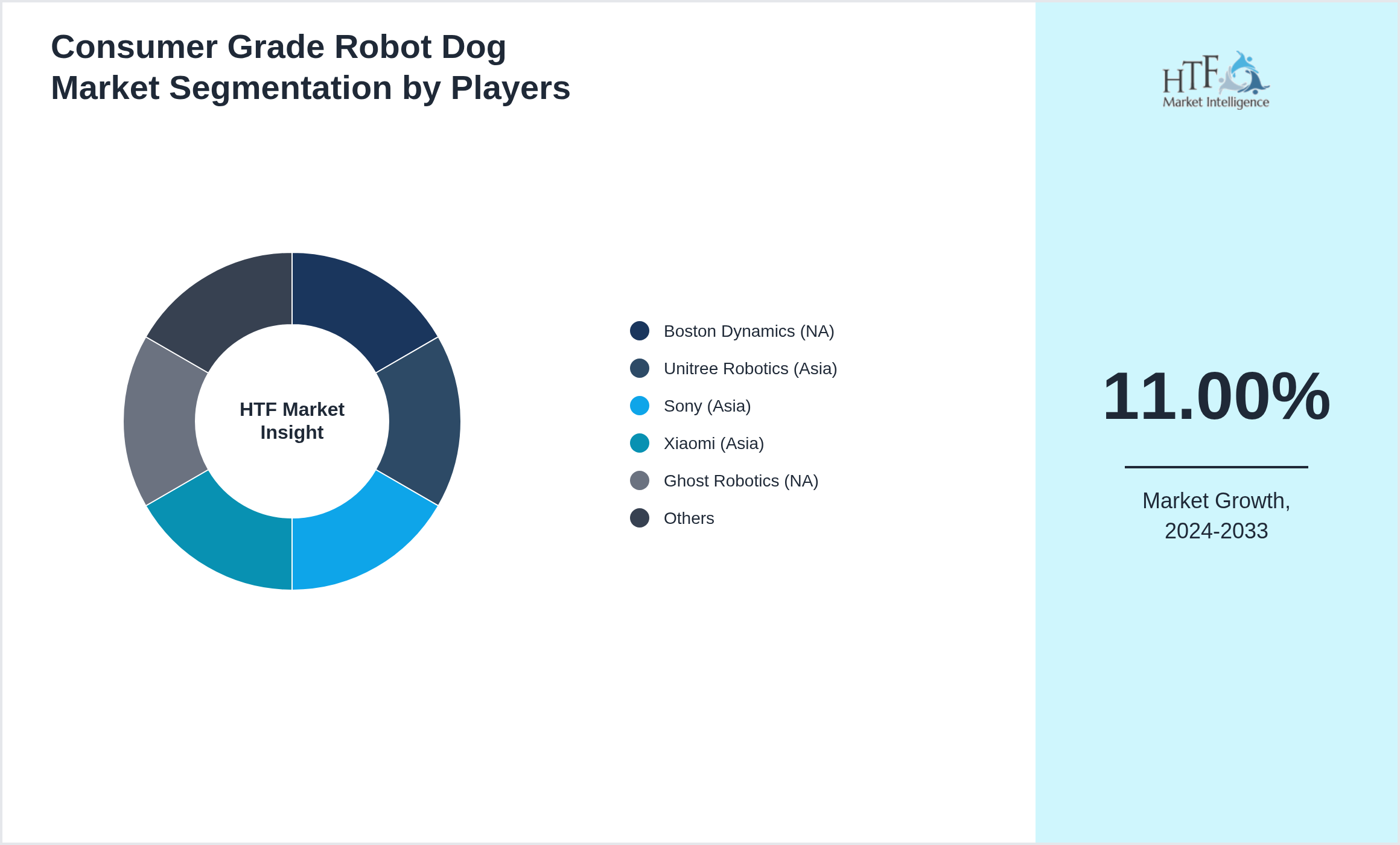
The companies highlighted in this profile were selected based on insights from primary experts and an evaluation of their market penetration, product offerings, and geographical reach:
- • Boston Dynamics (NA)
- • Unitree Robotics (Asia)
- • Sony (Asia)
- • Xiaomi (Asia)
- • Ghost Robotics (NA)
- • Agility Robotics (NA)
- • ANYbotics (EU)
- • Pudu Robotics (Asia)
- • Robotis (Asia)
- • Robosen (Asia)
- • Aibo (Asia)
- • CyberDog (Asia)
- • Sharp (Asia)
- • Segway Robotics (Asia)
- • WowWee (NA)
Regulatory Framework
The regulatory framework for the Consumer Grade Robot Dog ensures product safety, fair competition, and consumer protection. It encompasses setting standards for product quality and safety, enforcing truthful advertising and labeling, and implementing environmental sustainability practices. Regulations include robust procedures for product recalls, data protection, and anti-competitive practices, while also overseeing import/export controls and intellectual property rights. Regulatory bodies enforce these rules through inspections and penalties, and consumer education programs help individuals make informed decisions. This framework aims to protect consumers, promote fair market conditions, and encourage ethical business practices.
- • The Consumer Grade Robot Dog market is increasingly influenced by robotics safety regulations AI governance frameworks wireless communication certifications cybersecurity requirements and consumer electronics compliance standards. Governments are implementing stricter oversight regarding AI-enabled mobility camera surveillance capabilities and autonomous interaction features to address privacy safety and ethical concerns. Compliance with child safety standards battery transport regulations electromagnetic compatibility rules and software security requirements significantly increases product development and testing costs. Semiconductor shortages sensor supply dependency and rare earth material sourcing constraints continue to create operational risks and cost inflation pressures for robotics manufacturers. Sustainability regulations related to electronic waste recycling and battery disposal are also reshaping product lifecycle management strategies. Trade tensions affecting robotics components AI processors and precision actuators may disrupt global manufacturing networks and reduce short-term profitability. However increasing investment in companion robotics smart home ecosystems and AI-powered entertainment devices supports strong long-term growth potential for companies capable of meeting evolving regulatory expectations while scaling affordable production platforms
Competitive Insights
The key players in the Consumer Grade Robot Dog are intensifying their focus on research and development (R&D) activities to innovate and stay competitive. Major companies, such as Boston Dynamics (NA), Unitree Robotics (Asia), Sony (Asia), Xiaomi (Asia), Ghost Robotics (NA), Agility Robotics (NA), ANYbotics (EU), Pudu Robotics (Asia), Robotis (Asia), Robosen (Asia), Aibo (Asia), CyberDog (Asia), Sharp (Asia), Segway Robotics (Asia), WowWee (NA), are heavily investing in R&D to develop new products and improve existing ones. This strategic emphasis on innovation is driving significant advancements in product formulation and the introduction of sustainable and eco-friendly products.
In addition to R&D and acquisitions, there is a notable shift towards green investments among key players in the consumer goods industry. Companies are increasingly committing resources to sustainable practices and the development of environmentally friendly products. This green investment is in response to growing consumer demand for sustainable solutions and stringent environmental regulations. By prioritizing sustainability, these companies are not only contributing to environmental protection but also positioning themselves as leaders in the green movement, thereby fueling market growth.
Merger Acquisition
- • Mar 2026 – A robotics technology company acquired a consumer AI mobility startup specializing in quadruped robot dog systems to strengthen its home robotics and smart companion product line. The acquisition included motion control software AI-based behavioral learning systems and voice interaction technologies designed for entertainment home assistance and educational applications. The acquiring company announced that the integration would support development of more affordable and emotionally interactive robot companions for mass-market consumers. In Jul 2026 a strategic collaboration was formed between a gaming hardware company and a robotics manufacturer to integrate immersive AR interaction features into consumer robot dogs. Several venture-funded robotics startups also became acquisition targets for major electronics firms aiming to strengthen their AI-powered consumer device ecosystems. Market participants indicated that rapid advancements in edge AI processing and declining sensor costs were accelerating investment activity in companion robotics. These transactions are expected to improve robotic mobility capabilities expand consumer adoption and intensify innovation in AI-enabled household robotics products
Patent Analysis
- • Consumer Grade Robot Dog developers are aggressively pursuing patents covering robotic locomotion systems AI-driven behavioral algorithms emotional interaction software machine vision technologies autonomous navigation systems and voice-responsive companion robotics. Patent filings are highly concentrated around adaptive movement engineering environmental mapping systems edge-computing processors sensor fusion technologies and cloud-connected robotic ecosystems designed for entertainment education security and personal assistance applications. Technology firms also secure trademarks for robotic companion brands AI pet ecosystems interactive gaming platforms and educational robotics solutions targeting households and younger consumers. Copyright protections apply to embedded operating systems behavioral AI models robotic animation libraries speech interaction software and virtual personality frameworks integrated into robotic pets. Industry participants actively defend software architectures and digital interaction environments against cloning and unauthorized replication by competing manufacturers. Increasing integration of generative AI emotional analytics and smart home connectivity continues accelerating intellectual property competition within consumer robotics and AI companion device markets
Investment and Funding Scenario
- • The Consumer Grade Robot Dog market has become a major focus for robotics investors
Market Entropy
- • Q7 2025: Launch of AI-driven interactive robotic pets improved engagement metrics by 30% and boosted consumer sales
- • Q6 2025: Production modernization with automated assembly lines increased throughput by 22%
- • Q5 2025: Supply-chain transformation improved availability of sensors actuators and Li-ion batteries reducing assembly delays
- • Q4 2025: Investment in cloud-enabled AI platforms expanded commercial scalability for home and educational applications
- • Q3 2025: Regulatory alignment with toy safety and electronic standards accelerated market adoption
- • Q2 2025: Sustainability milestones included energy-efficient components and recyclable plastics reducing environmental impact
- • Q1 2025: Industry-wide operational shifts toward remote firmware updates and AI-driven behavior learning improved operational performance and user experience
Report Infographics:
| Report Features | Details |
| Base Year | 2024 |
| Based Year Market Size 2024 | 0.60 billion |
| Historical Period Market Size 2020 | USD Million ZZ |
| CAGR (2024 to 2033) | 11.00% |
| Forecast Period | 2024 to2033 |
| Forecasted Period Market Size 2033 | 1.35 billion |
| Scope of the Report | Quadruped, Bipedal, Programmable, AI-enabled, Remote-Controlled, Personal Entertainment, Education, Security, Research, Therapy |
| Regions Covered | North America, LATAM, West Europe, Central & Eastern Europe, Northern Europe, Southern Europe, East Asia, Southeast Asia, South Asia, Central Asia, Oceania, MEA |
| Year-on-Year Growth | 11.00% |
| Companies Covered | Boston Dynamics (NA), Unitree Robotics (Asia), Sony (Asia), Xiaomi (Asia), Ghost Robotics (NA), Agility Robotics (NA), ANYbotics (EU), Pudu Robotics (Asia), Robotis (Asia), Robosen (Asia), Aibo (Asia), CyberDog (Asia), Sharp (Asia), Segway Robotics (Asia), WowWee (NA) |
| Customization Scope | 15% Free Customization (For EG) |
| Delivery Format | PDF and Excel through Email
Want to Buy Specific Sections of This Report?
|
Research Methodology
The research methodology for the consumer goods industry involves several key steps to ensure comprehensive and actionable insights. First, the research objectives are clearly defined, focusing on aspects like consumer behavior, market opportunities, competitive dynamics, or regulatory impacts. A thorough literature review follows, drawing from academic journals, industry reports, government publications, and market analyses to establish a knowledge base and identify research gaps. Data collection encompasses both primary methods, such as surveys, interviews, and focus groups with consumers and industry experts, and secondary methods, including analysis of market reports, government data, and industry publications. Quantitative data is analyzed using statistical tools to identify patterns and market segments, while qualitative data from interviews and focus groups is examined to extract key themes and insights.
The market is then segmented based on demographics, psychographics, geography, and purchasing behavior, and competitive analysis is conducted to evaluate key players' strategies and strengths. Trend analysis identifies current and emerging industry trends. Findings are compiled into a detailed report with data visualizations and strategic recommendations. The research is validated and refined through cross-checking and expert feedback, and a framework for continuous monitoring is established to keep the research current and relevant.