
Performance Coaching Market Research Report
Performance Coaching Market - Global Share, Size & Changing Dynamics 2020-2033
Global Performance Coaching Market is segmented by Application (Leadership performance, Productivity, Career acceleration, Change management, Wellbeing), Type (Executive coaching, Behavioral coaching, Skills coaching, Hybrid coaching, AI-assisted coaching), and Geography (North America, LATAM, West Europe, Central & Eastern Europe, Northern Europe, Southern Europe, East Asia, Southeast Asia, South Asia, Central Asia, Oceania, MEA)
Pricing
Overview
The Performance Coaching plays a vital role in the global economy, covering products purchased by individuals for personal consumption. These goods are generally divided into two main categories: durable goods (e.g., appliances and furniture) and non-durable goods (e.g., food, beverages, and personal care items). The market is highly competitive, shaped by shifting consumer preferences and continuous innovation. In 2024, the global Performance Coaching market was valued at 3.1 billion and is projected to expand at a 12.30% from 2024 to 2033
Performance coaching delivers structured guidance to improve individual and leadership effectiveness through goal setting, feedback, and behavioral change. Delivered digitally or hybrid, it supports sustained performance improvement across roles and industries.
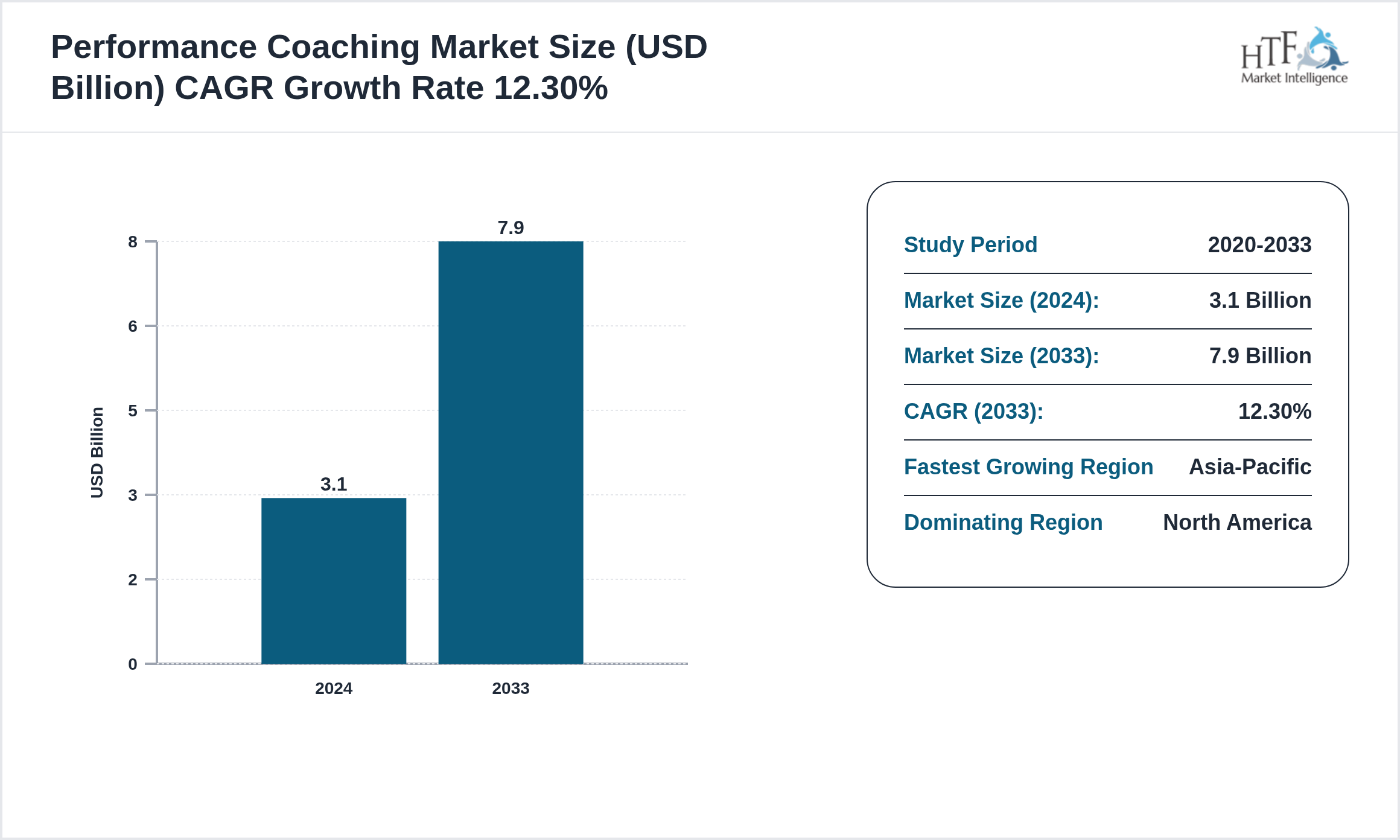
The research report shows the growth potential of the global Performance Coaching market. The market for Performance Coaching is anticipated to increase steadily. For Performance Coaching to be widely used, supply chain optimization, cost reduction, and product differentiation are still essential. For market participants to take advantage of the enormous prospects offered by the Performance Coaching market, they must make R&D investments, establish strategic alliances, and match their products with changing customer tastes.
Performance Coaching Market Dynamics
Numerous elements impact market dynamics in this industry, including evolving consumer preferences, legal requirements, and technological advancements.
Market Driver:
The report can identify and analyze the factors driving the growth of the Performance Coaching Market. Including {DRIVER_TEXT}
- • Performance pressure
The increasing demand for Performance Coaching is one of the factors driving the market’s growth.
- • Hybrid coaching
Server factors driving the Performance Coaching market’s opportunity.
- • SME coaching
What challenges are facing the Performance Coaching market?
- • ROI attribution
The Performance Coaching market is expected to grow at a compound annual growth rate (CAGR) of 12.30% from 2024 to 2033, reaching an estimated value of 7.9 billion by 2033 with a year-on-year growth rate of {YOY_GROWTH}. This expansion is fueled by factors such as technological innovations, rising consumer demand, and the influence of globalization, which together open new opportunities for market participants. To capitalize on this growth, businesses should focus on enhancing product offerings, utilizing digital marketing strategies, and exploring untapped markets to broaden their reach and boost revenue.
The Asia-Pacific is experiencing the fastest growth, driven by its rapidly increasing population and expanding economic activity across key sectors. This acceleration is supported by growing urbanization, infrastructure development, and favorable government policies promoting industrial growth. Additionally, the region benefits from a youthful, expanding workforce and rising consumer demand. In contrast, North America remains the market leader, maintaining its dominance through well-established industries, technological innovations, and a strong global presence.
North America continues to lead in technology, healthcare, and aerospace, with Silicon Valley as a global innovation hub and the U.S. excelling in pharmaceutical research and defense. The region is making significant investments in renewable energy, advanced manufacturing, and electric vehicles (EVs) to maintain its competitive edge and drive decarbonization efforts.
Europe stands out in the automotive, renewable energy, and luxury goods sectors, with Germany at the forefront of automotive manufacturing and countries like Denmark and the UK spearheading wind energy initiatives. Europe is prioritizing green energy transitions, particularly in green hydrogen and offshore wind, while advancing digital transformation in areas like AI, cybersecurity, and blockchain, alongside its leadership in sustainable, circular economy practices.
The Asia-Pacific region is a major player in manufacturing, semiconductors, and fintech, with China, Japan, South Korea, and Taiwan dominating these industries. The region is investing heavily in 5G infrastructure, AI, and smart city projects while expanding renewable energy capabilities in solar, wind, and hydropower.
Latin America excels in agriculture, commodities, and mining, with Brazil, Argentina, Chile, and Peru leading in the production of agricultural goods and minerals like copper and lithium. The region is focused on infrastructure development, digital economy growth, and sustainable agriculture to foster economic development and environmental resilience.
In the Middle East and Africa, the oil and gas industry continues to dominate, especially in Saudi Arabia, the UAE, and Qatar. However, these regions are increasingly diversifying their economies through investments in renewable energy and digital transformation. Africa, with its rich mineral resources, is also seeing growing investments in healthcare and education, aimed at improving human capital and economic stability.
- North America
- LATAM
- West Europe
- Central & Eastern Europe
- Northern Europe
- Southern Europe
- East Asia
- Southeast Asia
- South Asia
- Central Asia
- Oceania
- MEA
Key Players
The companies profiled were selected based on insights from industry experts and a thorough evaluation of their market influence, product range, and geographical presence.
- • BetterUp (USA)
- • CoachHub (Germany)
- • Torch (USA)
- • Ezra (UK)
- • Sounding Board (USA)
- • FranklinCovey (USA)
- • Korn Ferry (USA)
- • CCL (USA)
- • BTS (EU)
- • Deloitte (Global)
- • PwC (Global)
- • Mercer (USA)
- • Accenture (Global)
- • Skillsoft (USA)
- • LinkedIn (USA)
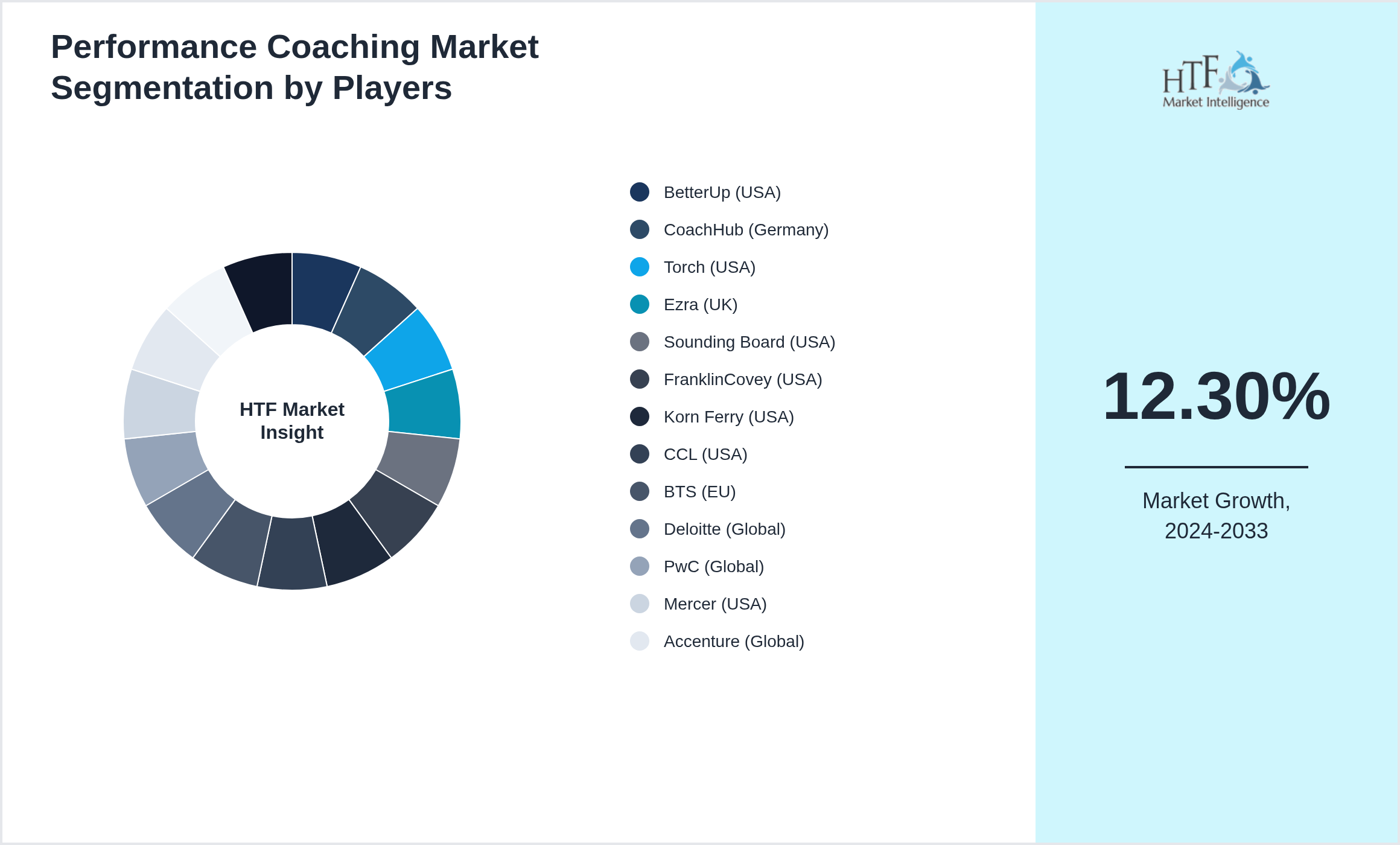
Companies are increasingly focused on expanding their market share through strategic initiatives such as mergers, acquisitions, and green investments, particularly in underserved regions. These strategies are helping companies capture a larger market share while fostering sustainable development. By consolidating resources and widening their geographical reach, these companies not only enhance their competitive position but also align with global trends in sustainability and corporate responsibility.
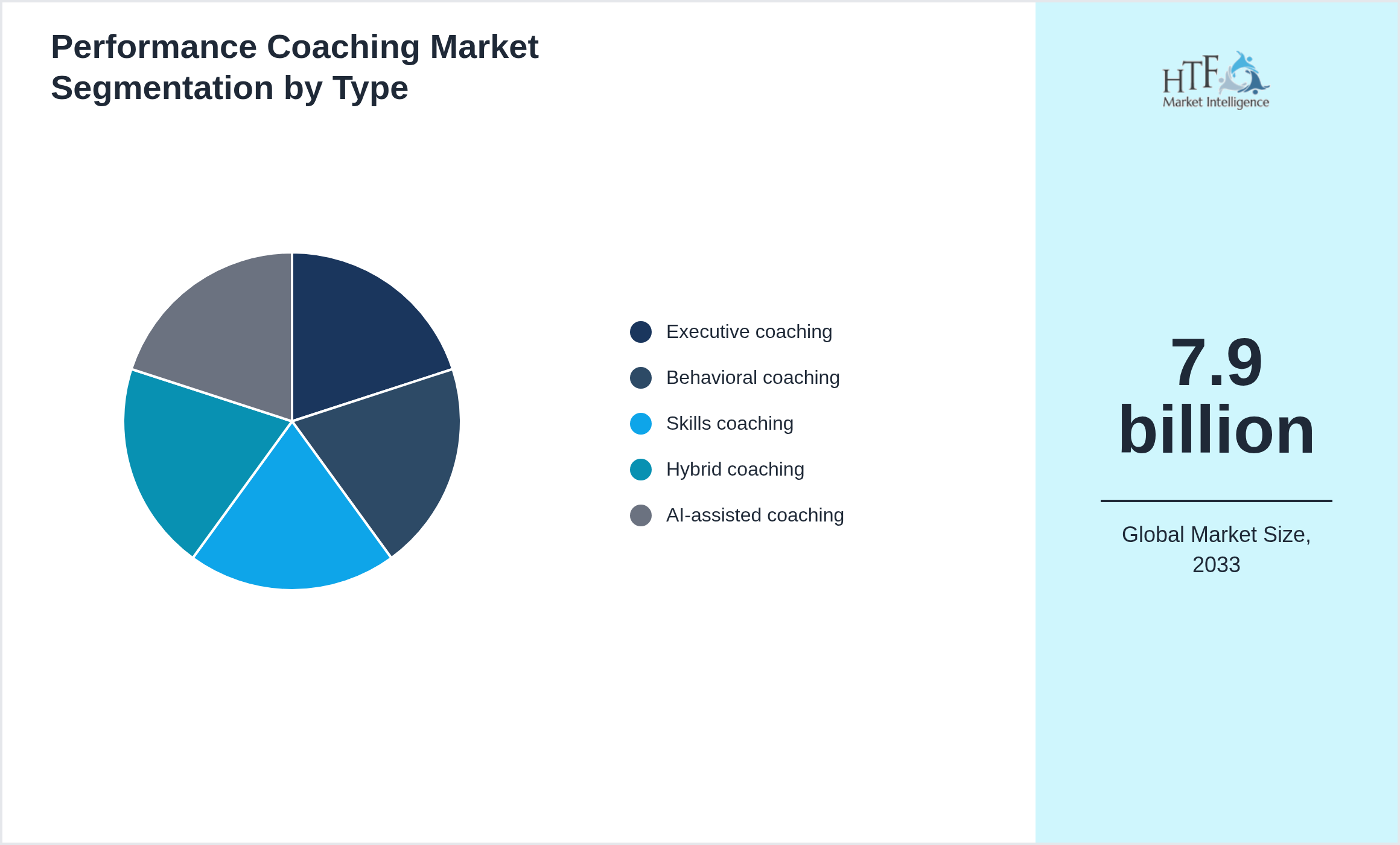
Segmentation by Type
- • Executive coaching
- • Behavioral coaching
- • Skills coaching
- • Hybrid coaching
- • AI-assisted coaching
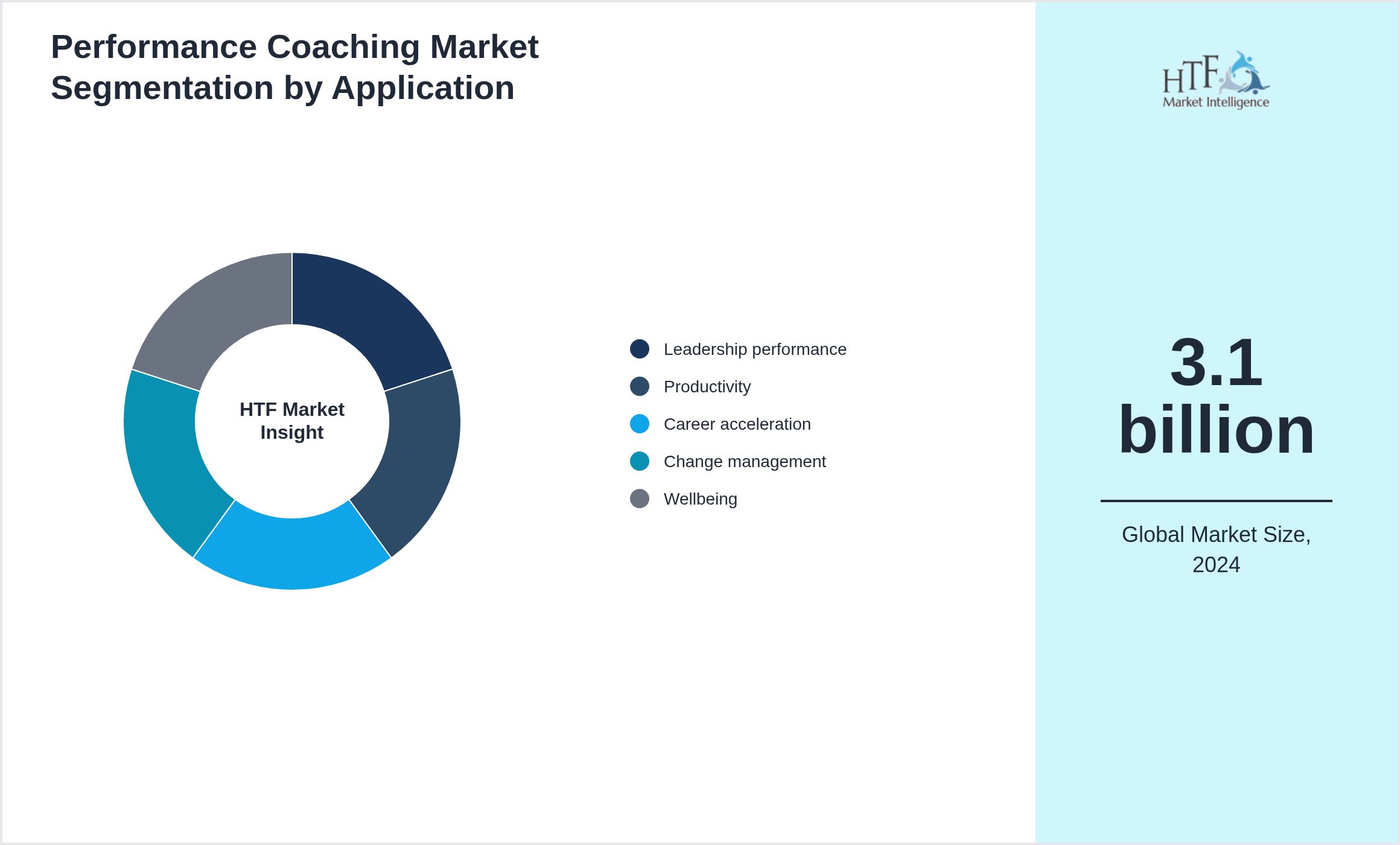
Segmentation by Application
- • Leadership performance
- • Productivity
- • Career acceleration
- • Change management
- • Wellbeing
This report also analyzes the market by region, providing insights into geographical differences in market performance.
- North America
- LATAM
- West Europe
- Central & Eastern Europe
- Northern Europe
- Southern Europe
- East Asia
- Southeast Asia
- South Asia
- Central Asia
- Oceania
- MEA
Regional Analysis
- • Europe leads adoption with Germany and the Netherlands investing heavily in hydrogen corridors. California is the US frontrunner. Japan and South Korea are also deploying pilot fleets and refueling networks.
- • Nov 2023 – PerformCoach launched executive performance coaching programs combining behavioral science and leadership metrics.
- • Aug 2025: BetterUp acquired PeakPerformance Coaching to expand performance coaching programs for enterprise clients. Nov 2025: CoachHub purchased PerformanceCoach Pro to add OKR-aligned coaching and manager enablement toolkits.
- • Regulations are supportive
- • Patent focus includes fuel cell stack efficiency
- • Government grants
Report Infographics
| Report Features | Details |
| Base Year | 2024 |
| Based Year Market Size 2024 | 3.1 billion |
| Historical Period | 2020 to 2024 |
| CAGR 2024 to 2033 | 12.30% |
| Forecast Period | 2026 to 2033 |
| Forecasted Period Market Size 2033 | 7.9 billion |
| Scope of the Report | Executive coaching, Behavioral coaching, Skills coaching, Hybrid coaching, AI-assisted coaching, Leadership performance, Productivity, Career acceleration, Change management, Wellbeing |
| Regions Covered | North America, LATAM, West Europe, Central & Eastern Europe, Northern Europe, Southern Europe, East Asia, Southeast Asia, South Asia, Central Asia, Oceania, MEA |
| Companies Covered | BetterUp (USA), CoachHub (Germany), Torch (USA), Ezra (UK), Sounding Board (USA), FranklinCovey (USA), Korn Ferry (USA), CCL (USA), BTS (EU), Deloitte (Global), PwC (Global), Mercer (USA), Accenture (Global), Skillsoft (USA), LinkedIn (USA) |
| Customization Scope | 15% Free Customization |
| Delivery Format | PDF and Excel through Email |
R Regulatory Framework of Market Research
The regulatory framework governing market research reports ensures transparency, accuracy, and ethical conduct in data collection and reporting. Compliance with relevant legal and industry standards is critical to maintaining credibility and avoiding penalties.
- Data Privacy and Protection: Regulations such as the General Data Protection Regulation (GDPR) in the EU and the California Consumer Privacy Act (CCPA) in the US mandate strict guidelines for handling personal data. Market research firms must ensure that all data collection methods comply with privacy laws, including obtaining consent and ensuring data security.
- Fair Competition: Regulatory bodies such as the Federal Trade Commission (FTC) in the US and the Competition and Markets Authority (CMA) in the UK enforce fair competition practices. Research reports must avoid biased or misleading information that could distort competition or consumer choice.
- Intellectual Property: Compliance with copyright laws ensures that the content used in market research reports, such as proprietary data or third-party insights, is legally sourced and cited to avoid infringement.
- Ethical Standards: Industry organizations, like the Market Research Society (MRS) and the American Association for Public Opinion Research (AAPOR), set ethical guidelines that dictate transparent, responsible research practices, ensuring that respondents’ rights are respected and findings are presented without manipulation.
{SIDE TAG Key highlights of the Report}
• CAGR of the market during the forecast period 2024 -2033
• In-depth information on growth factors that will accelerate the Performance Coaching market in the next few years.
• Detailed Insights on futuristic trends and changing consumer behavior in Performance Coaching .
• Forecast of the Performance Coaching market size and its contribution to the parent market by type, application, and by Region and Country.
• A broad view of customer demand in Performance Coaching Industry
• Uncover market’s competitive landscape and in-depth information on various players
• Comprehensive information about factors that will challenge the growth of Performance Coaching players
Performance Coaching - Table of Contents
Chapter 1: Market Preface
Chapter 2: Strategic Overview
Chapter 3: Global Performance Coaching Market Business Environment & Changing Dynamics
Chapter 4: Global Performance Coaching Industry Factors Assessment
Chapter 5: Performance Coaching : Competition Benchmarking & Performance Evaluation
Chapter 6: Global Performance Coaching Market: Company Profiles
Chapter 7: Global Performance Coaching by Type & Application (2020-2033)
Chapter 8: North America Performance Coaching Market Breakdown by Country, Type & Application
Chapter 9: Europe Performance Coaching Market Breakdown by Country, Type & Application
Chapter 10: Asia Pacific Performance Coaching Market Breakdown by Country, Type & Application
Chapter 11: Latin America Performance Coaching Market Breakdown by Country, Type & Application
Chapter 12: Middle East & Africa Performance Coaching Market Breakdown by Country, Type & Application
Chapter 13: Research Finding and Conclusion
Frequently Asked Questions (FAQ):
The Compact Track Loaders market is projected to grow at a CAGR of 6.8% from 2025 to 2030, driven by increasing demand in construction and agricultural sectors.
North America currently leads the market with approximately 45% market share, followed by Europe at 28% and Asia-Pacific at 22%. The remaining regions account for 5% of the global market.
Key growth drivers include increasing construction activities, rising demand for versatile equipment in agriculture, technological advancements in track loader design, and growing preference for compact equipment in urban construction projects.